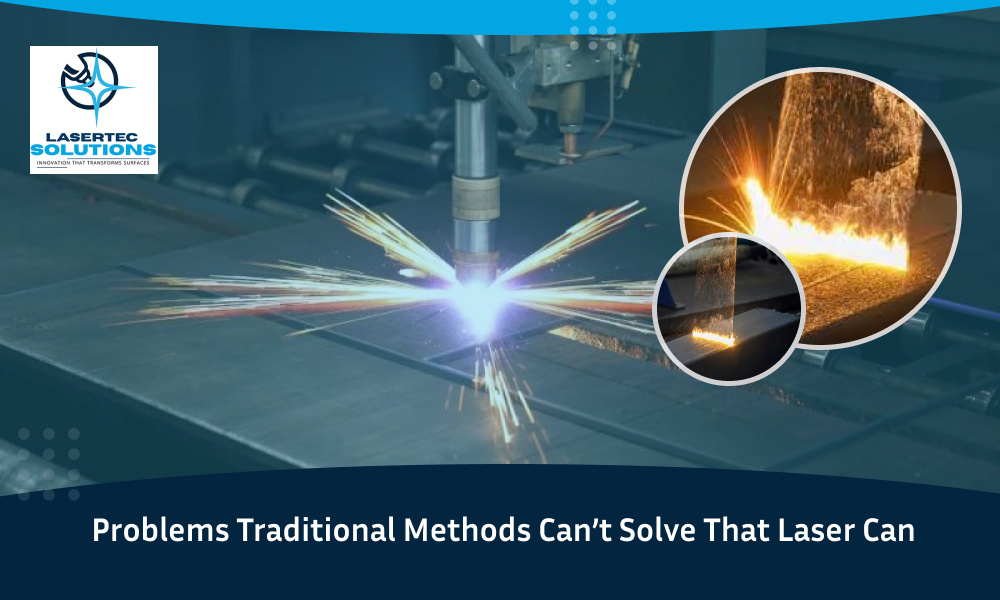
In manufacturing and engineering, surface preparation isn’t just about appearance—it’s about performance, compliance and reliability. Yet, traditional methods like sandblasting, thermal treatment, grinding, manual scrubbing and chemical cleaning often fall short in meeting the demands of modern industries such as food manufacturing, plastics production, heavy industries and precision engineering.
At Lasertec Solutions, our laser-based surface treatment technology addresses these challenges head-on. Here’s how we solve five persistent problems traditional methods can’t.
Surface Damage from Abrasion
Sandblasting and grinding are aggressive. They remove contaminants, but they also strip away part of the base material, which can alter tolerances or weaken a surface. This is a major issue for engineering companies working on motors, compressors or hydraulic components, where precision is critical.
Laser treatment selectively removes the contamination—rust, paint or residue—without altering the substrate.
Residual Contamination
Chemical cleaning often leaves residue, and abrasive blasting leaves grit embedded in the surface. In the food industry, even microscopic contamination is unacceptable under HACCP and FSANZ requirements.
Laser cleaning is a dry, contactless process—no solvents, no grit, and no need for post-cleaning rinses. That means safer surfaces for direct or indirect food contact, and no risk of foreign object contamination.
Accessing Complex or Delicate Surfaces
Traditional tools can’t reach fine grooves, threads or internal surfaces without risk of damage. For example, in plastics manufacturing, moulds often have intricate details where blasting would round edges or alter cavity profiles.
Laser systems can precisely target these surfaces, even in confined or complex geometries, without affecting their dimensions.
Meeting Environmental and Safety Standards
Chemical stripping generates hazardous waste, and blasting produces airborne dust—both of which have increasing compliance costs. Food manufacturers face strict environmental discharge limits, while engineering companies must manage workplace safety and waste disposal.
Laser cleaning eliminates chemical effluent and reduces airborne hazards, helping businesses stay compliant without costly containment measures.
Reducing Downtime
Setup, cleanup and waste disposal from traditional methods can keep critical equipment offline for hours or even days. In high-output industries like packaging, every minute of downtime has a direct cost.
Laser treatment is fast, requires minimal preparation and produces little to no waste—getting equipment back in service quickly.
Bottom line: In sectors where precision, hygiene and compliance are non-negotiable, laser-based surface treatment/cleaning isn’t just a better alternative—it’s a necessary upgrade. The question is no longer whether laser can replace traditional methods, but how much it could save your business in time, compliance costs and rework.
Word count: ~480
At Lasertec Solutions, we go beyond surface-level cleaning to deliver real performance benefits for your business. Our advanced laser cleaning systems help you reduce operational costs, improve equipment longevity, and ensure consistent product quality.
Copyright Ⓒ 2025 All Right Reserved By Lasertec Solutions | Designed by : SEO Company in Ahmedabad - Aom Web Designer
Be the first to know about new arrivals and promotions